Dish You Were Here: Six UK Science Sites That Keep Stealing the Scene
There is a particular kind of British science building that looks less like a workplace and more like a film set waiting for a villain. You know the sort: a control room with a dozen mismatched monitors, a corridor that smells of floor polish and ozone, and a piece of apparatus so large it has its own postcode. British science does not need a fictional lair. It has Jodrell Bank.
This is not a list of cool buildings. It is a location tour with a lab coat on. Each entry pairs a screen recommendation with a plain-English explainer and the verdict from the people who actually work there. The through-line is simple: cameras love science because science is full of scale, repetition and visible purpose. A control room reads as consequence. A dish reads as listening. A tokamak reads as "please do not touch the universe".
1. Jodrell Bank Observatory, Cheshire
Screen recommendation: Doctor Who in any era that needs a dish and a sense of cosmic dread, or the ITV drama The Last Train for a more grounded kind of ruin.
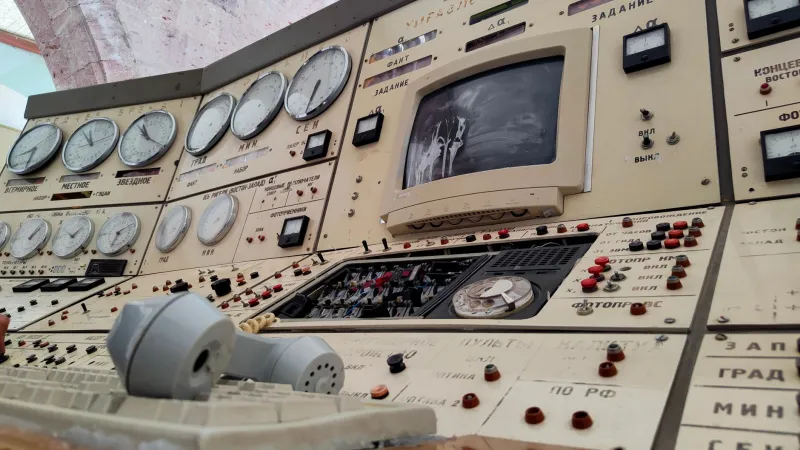
Real science: The Lovell Telescope is a 76-metre radio dish that has been listening to the sky since the 1950s. It picks up radio waves from pulsars, quasars and clouds of hydrogen, and it has also tracked spacecraft and helped with meteor radar. The control room is a proper nest of screens, dials and tea-making equipment.
Why it films well: A giant parabolic dish is basically a face. It turns, it tilts, it has intention. Put a small human in the foreground and the dish becomes a monument to curiosity with a sideline in looming.
Staff verdict: The dish is not a death ray. It mostly listens. Visitors ask whether it talks to aliens; the honest answer is that it is far more interested in cold gas, precise timing and the occasional spacecraft. The drama is in the data, not the laser noise.
2. Culham Centre for Fusion Energy, Oxfordshire
Screen recommendation: The Saint for tokamak-as-villain-lair energy, or a JET farewell documentary if you want the real thing without a henchman in a wetsuit.
Real science: JET, the Joint European Torus, was for decades the largest tokamak of its kind. It used powerful magnetic fields to hold a hot plasma in a doughnut shape and tried to persuade hydrogen isotopes to fuse. The hall is a cathedral of pipes, remote-handling arms and warning signs.
Why it films well: Fusion kit has the perfect screen grammar: enormous, circular, slightly forbidden. It looks like something built by engineers who were told to make a power station and accidentally made a science-fiction altar.
Staff verdict: The reality is vacuum vessels, diagnostics, permits and a great many meetings. Nobody runs down a corridor shouting about containment while holding a clipboard. The most dramatic moment is usually a vacuum pump doing exactly what it was asked to do.
3. Rutherford Appleton Laboratory, Oxfordshire
Screen recommendation: Doctor Who or The Sarah Jane Adventures for the secret British research base vibe, or a neutron-scattering documentary if you prefer your mysteries measured in angstroms.
Real science: RAL hosts the ISIS Neutron and Muon Source, the Central Laser Facility and space-science teams. Neutrons are fired at samples to reveal structure; lasers do precision experiments at frankly silly intensities; instruments are built for spacecraft and then tested on the ground.
Why it films well: The campus is a maze of hangars, instrument huts and corridors that look like they were designed by a committee of very sensible people who had once seen a Bond film. It reads instantly as a place where something important is being contained, measured or quietly signed for.
Staff verdict: The most dramatic thing on site is often a vacuum pump and a deadline. The coffee is the real containment issue. And yes, the corridors are as confusing in real life as they look on screen.
4. Dungeness B nuclear power station, Kent
Screen recommendation: Any Doctor Who episode that treats a quarry as a planet, or a nuclear-power documentary for the unglamorous truth about turbines and permits.
Real science: Dungeness B was an advanced gas-cooled reactor, using graphite as a moderator and carbon dioxide as a coolant to drive steam turbines. It stopped generating in 2021, but the site remains a monumental piece of engineering set on a shingle headland that looks like the end of the world with better signage.
Why it films well: Concrete, pylons, shingle and sea light. It is a power station that already looks like a location scout's mood board. No set dressing required; just add a brooding sky and a scientist with a clipboard.
Staff verdict: Engineers tend to describe it as a workplace full of procedures, valves and checklists. On screen, nuclear sites are always about to melt down. In real life, the suspense is whether the paperwork will clear before lunch.
5. Royal Observatory Greenwich, London
Screen recommendation: Thor: The Dark World for Greenwich doing superhero duty, or The Theory of Everything for a gentler period-astronomy mood.
Real science: The observatory is the home of the prime meridian, centuries of timekeeping and a working tradition of public astronomy. Its telescopes and domes tell the story of how Britain tried to organise the sky and, more successfully, organise the clock.
Why it films well: Domes, colonnades and a hilltop view do a lot of heavy lifting. It is instant science without a lab coat: the architecture says "we measure the universe here" and the tourists say "where is the meridian line?"
Staff verdict: The most common question is not about the prime meridian. It is about aliens. Astronomers are patient about this. The meridian line, meanwhile, is less a cosmic threshold and more a queue with a selfie habit.
6. The Royal Institution, London
Screen recommendation: Any Christmas Lectures clip for pure demo energy, or The Prestige for Victorian lab vibes and questionable electrical enthusiasm.
Real science: The Royal Institution is where Faraday worked, where the Christmas Lectures have been performed since the 19th century, and where public science still gets a proper theatre. The lecture room has tiered wooden seating, gas taps and the unmistakable smell of chalk dust and history.
Why it films well: It is not a lab in the sterile sense. It is a laboratory with a stage. The architecture says science is a performance, which is exactly what a camera wants to hear.
Staff verdict: The theatre is a time machine. The real experiment is getting a live demo to work before the cameras roll, while a presenter smiles through the part where the apparatus makes a noise it definitely did not make in rehearsal.
Why control rooms keep winning
Control rooms are legible. Screens, knobs, warning lights and countdowns give actors something to do with their hands. Big instruments give scale, and British facilities often have a useful layer cake of history: wartime huts, Cold War concrete and modern kit bolted on with cable ties and hope. That mix is catnip for directors because it looks expensive without necessarily being a set.
There is also the science of visual contrast. A lone researcher in a huge hall reads as vulnerability; a bank of monitors reads as consequence; a laminated safety notice reads as truth. If a film shows a laboratory with no kettle, it is fantasy. If it shows a control room where someone has taped a handwritten sign to a million-pound instrument, it is practically a documentary.
How to watch like a local
Keep an eye out for the tea mug, the wonky chair and the safety notice that has been photocopied so many times it is now grey. Those are the tells. British science sites are not just backdrops; they are characters with bad lighting and excellent signage. Next time a film needs a villain's lair, it could simply ring Jodrell Bank. The dish will not answer, but it will listen.