The Same Beaker Twice: Inside Britain's Unofficial Science-Prop Circuit
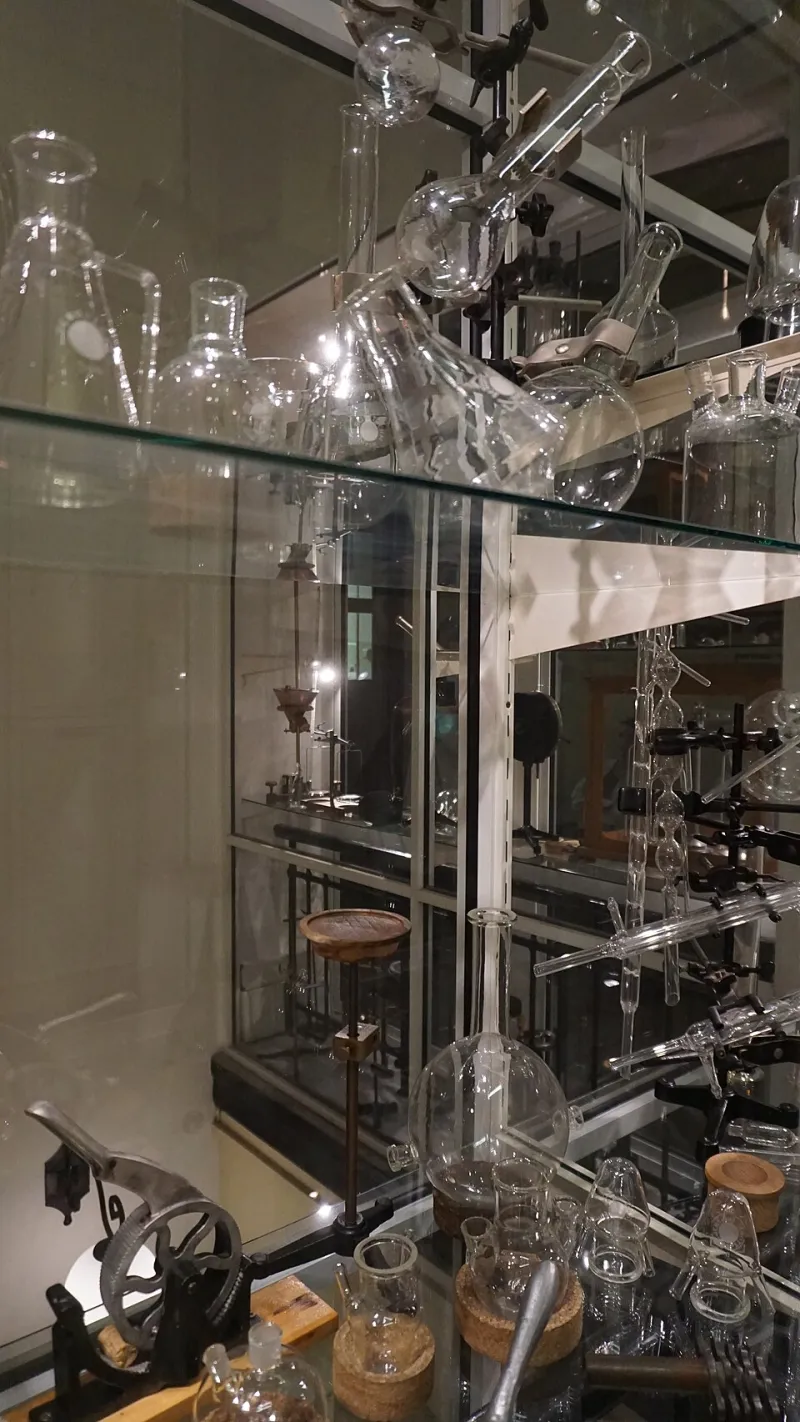
Photo: LukaszKatlewa, CC BY-SA 4.0, via Wikimedia Commons
There is an oscilloscope. It is grey, boxy, probably older than the person operating it on screen, and it has appeared in a schools programme, a BBC Four documentary about radar, a children's show about electricity and at least one drama in which it is supposed to be a machine that reads minds.
If you have watched British science television for more than a decade, you have seen this oscilloscope. You may have seen it in two different decades, playing two different jobs.
This is not a scandal. It is a craft. Britain has, in effect, a repertory company of scientific objects — a stock cast of instruments, glassware and coats that gets booked, wrapped, trucked and returned, and which has quietly trained several generations of viewers to recognise a laboratory on sight. The props are the supporting artistes of the nation's science broadcasting, and like all good supporting artistes, they are doing more work than you notice.
The warehouse off the A40
The circuit starts in the places props live. A hire house on the edge of a city, a couple of industrial units, one very organised person with a spreadsheet. Big feature films build bespoke labs; television reuses. That's not laziness, it's arithmetic.
"You can't build a lab for a three-day shoot," says one prop master with twenty years of science-adjacent credits. "You hire. You hire a bench, a sink unit, four stools, and then you go shopping in the shelves for the things the audience will actually look at. Which is never the bench. It's the glass."
The glass is the recurring character. Conical flasks, beakers, the tall measuring cylinders that make a bench look purposeful, and — reliably — something bubbling. Prop stores keep bubbling kit in a particular corner, because it comes back in a particular state.
"Bubble rigs are a nightmare," he says cheerfully. "Air pump, tube, water, a bit of glycerine so the bubbles behave. It looks like nothing on a bench and it looks like absolutely everything on camera. You can have a completely inert scene and the moment the bubbles go, the audience thinks: science. Or possibly: potion. Depends on the music."
Then there's the instrumentation. Analogue scopes, signal generators, boxes with dials and satisfyingly heavy switches. Much of it is genuinely old, sourced from university disposals, Ministry of Defence surplus, or the great slow tide of retired hospital equipment.
"A modern digital instrument looks like a laptop," says another prop master. "Nobody believes a laptop. A dial says 'this person knows something I don't.'"
How a prop becomes a signal
Archive curators see the same objects from the other end. In the BFI's television collections and the regional film archives, the lab has a visual grammar that stabilises in roughly the 1960s and then refuses to move.
"You can watch a 1972 schools programme and a 2019 drama and the visual vocabulary is nearly identical," says a curator who has catalogued decades of educational television. "Coat, bench, glassware, instrumentation, and a title card. The content changes completely; the props barely budge. That's not a failure of imagination. It's a convention, and conventions are efficient. A viewer knows what room they're in within a second of the shot."
Efficiency, though, curdles into mythology. The bubbling flask has no specific meaning and therefore takes on every meaning. It becomes a shorthand for chemistry, then for science in general, then — in thriller hands — for something that will kill everyone in Act Three.
"The shorthand is fine until it replaces a fact," the curator adds. "I've had researchers ask for footage of 'a proper lab.' What they mean is a lab that looks like telly. Which is a small closed loop, and it gets smaller every year."
That loop is worth naming. When the same beaker plays the same role for fifty years, it stops being a detail and becomes an assumption — and assumptions are what documentaries are supposed to puncture. The apothecary jar, the brass microscope, the tank of green fluid: all lovely, all accurate to something, none of them representative of the room where the work actually happened last Tuesday.
The children's-TV wing of the circuit
If you want to see the repertory company at full strength, watch children's science telly. The budget is smaller, the shoot is faster, the props are borrowed from further down the same shelves — and the result is a kind of heightened, cheerful, extremely legible science that children's programmers defend fiercely.
"Kids don't need a real lab, they need a promise of a lab," says a producer of two children's science series. "The coat has to be too big. The goggles have to be slightly ridiculous. The bench has to look like it might explode, harmlessly. What we're selling is: this is a place where things are found out."
She's careful about one thing, though: which experiments get recreated at home. "The prop circuit has a moral edge. If we make bubbling green stuff look like a normal Tuesday, a nine-year-old will try it. The visual shorthand that makes the telly work is exactly the thing we then have to walk back in the links."
Return, wrap, repeat
What emerges from the tour is that the circuit is not a secret and never has been. It's a supply chain. Props go out, get wrapped, come back, get repaired, go out again playing something slightly different. A field kit becomes a crime-scene kit becomes a geology kit, with three knobs changed and a new label.
And that's the useful thing to hold in your head next time a character in a British drama lifts a conical flask and announces a breakthrough. The flask is not a fact. It is an actor, on its seventeenth booking, doing what actors do: standing in for something the production couldn't afford to build and the audience can't be bothered to doubt.
Which is fine. Just remember that the oscilloscope has range, and one of these days somebody should give it the lead.