Boot-Full of Beakers: Six Filmed British Science Roadshows That Beat a Studio Audience
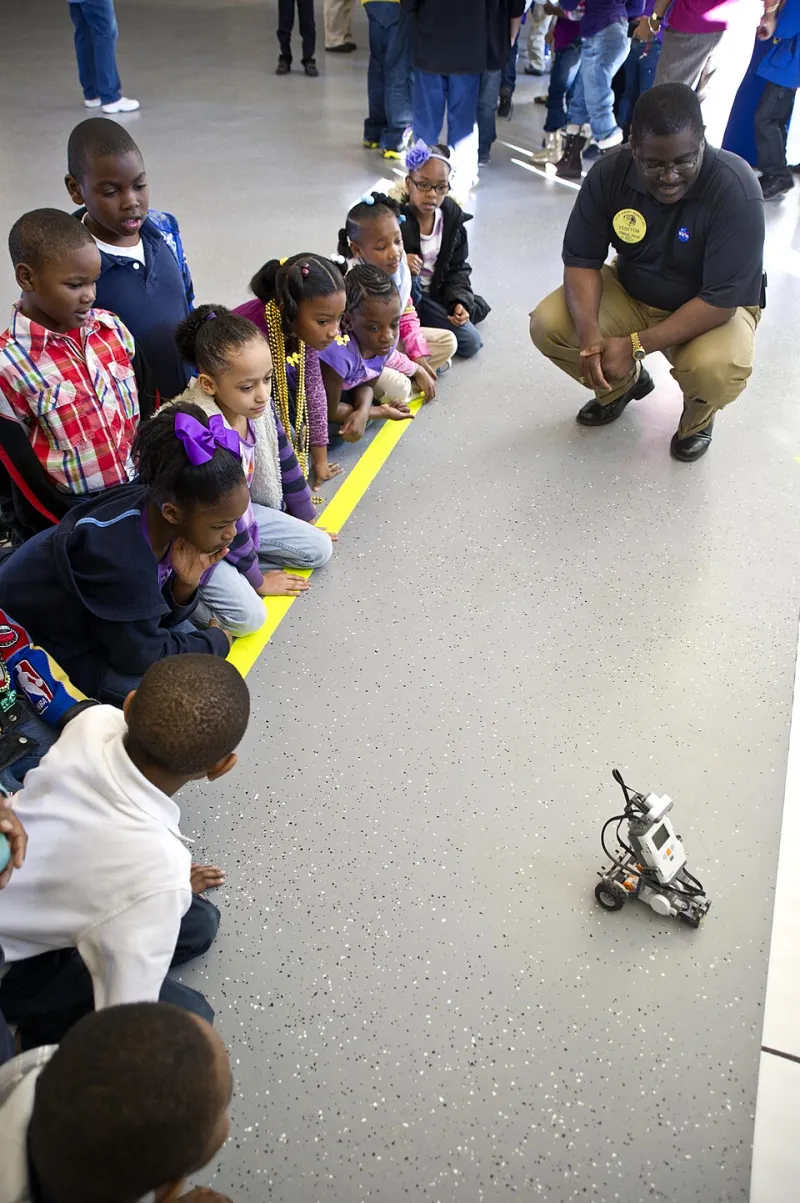
Photo: NASA Stennis Space Center, Public domain, via Wikimedia Commons
There is a particular smell to a parish hall at ten past nine in the morning. Floor polish, urn steam, and the faint ghost of last week's jumble sale. Into this setting, once a year, somebody wheels a flight case containing a Van de Graaff generator, three boxes of nitrile gloves and a laminated risk assessment, and the science begins.
Television rarely films this. It films the lecture theatre, the shiny bench, the po-faced presenter striding past a fume cupboard. But the roadshow — the county-show tent, the library circuit, the pub back room — is where most Britons actually meet a scientist in the flesh. And enough of it has been caught on camera, usually by a local film crew with one tripod and a lot of optimism, that we can assemble a viewing list.
Why the village hall flatters science more than the studio
Studio science is edited towards certainty. Roadshow science cannot be, because the audience is four feet away and the demonstration either works or it doesn't, in real time, in front of a child who has already asked whether it will explode.
That liveness is the whole appeal. When a presenter has to hold a room of forty people, half of them under eleven and one of them determined to press the button, the science stops being a script and becomes a negotiation. Cameras that catch it tend to catch something rarer than spectacle: competence under pressure.
The Bang Goes the Theory roadshow years
When the BBC One science series took itself on the road between 2009 and 2014, it produced the definitive filmed record of the format — a live show that behaved like a gig, with a demo rig, a front-of-house team and the distinct sense that everything could go wrong by half past two. Clips from those dates circulate widely, and the best of them are not the explosions. They are the moments where a presenter crouches down to explain a failed experiment to a disappointed eight-year-old without condescending to her. That is a harder skill than hitting a target with a rocket.
What the footage reveals is a roadshow built like a touring band: same set, new town, local schools in the afternoon, public show in the evening. The repetition is the point. By the fortieth date, the patter is bulletproof and the demos have been sanded down to the ones that survive a humid church hall.
Guerrilla Science and the field as a laboratory
The UK-born outfit that took research into festivals — Glastonbury mud, Latitude drizzle, the whole damp pageant — produced some of the most watchable outreach footage we have. Because the setting is wrong for science in every way, the scientists have to work. There is no lectern, no lighting rig, no audience already persuaded. There is a curious person holding a pint who has wandered in because the tent looked interesting.
Documentaries and short films shot in that environment capture something the studio cannot fake: the conversion moment. The visible shift from polite interest to genuine question. If you want to know whether a science communicator is any good, watch them handle someone who did not come to be educated.
Pint of Science: the back room as lecture theatre
Starting in London pubs in 2012 and spreading across the country, this format did something quietly radical — it put researchers in front of adults who had chosen an evening out, not an Open Day. Filmed highlights from these nights are scrappy, badly lit and completely compelling, largely because the speakers have to earn attention from a room that is not obliged to give it.
There is a specific British comedy in watching a postdoctoral researcher attempt to explain quantum tunnelling over the sound of a fruit machine. The footage is not prestige television. It is better than that: it is evidence.
Cheltenham's Discovery Zone and the annual migration
The festival's free-to-enter zone has been filmed, photographed and news-reported for years, and the resulting archive functions as a national register of what actually holds a family's attention. The answer, consistently, is not the biggest demo. It is the thing they can touch, break, or take home in a paper bag.
Note the crowd flow in any festival footage: the queue forms at the table with the most tactile props and the shortest explanation. Whatever the stand is selling, the format has already taught the audience that science is a thing you do with your hands. Producers who forget this end up with beautiful films nobody finishes.
FameLab heats: the regional eliminator as drama
The Cheltenham-born speaking competition runs heats in rooms across the UK, and the regional rounds are the most honest television that science communication has ever accidentally produced. Three minutes, no slides, a panel with a stopwatch. Filmed heat footage is unforgiving: you can see precisely when a researcher loses a room and precisely what they do about it.
It is also very funny. A climatologist attempting a metaphor about a duvet while the fire alarm tests in the corridor outside is British public science in its purest state.
County shows and the tombola adjacency
The Great Yorkshire Show and its kin have hosted science stands for decades, and local news coverage of them is a genre of its own. The framing is always the same: a child in wellies, a presenter in a lab coat, a sign that says something about DNA. What those clips show is the true function of the roadshow — it is not a lecture, it is a stall. It competes with the tombola and the cake tent and the sheep, and when it wins, it wins on charm.
What the glossy end still misses
The roadshow archive is a correction to a habit of mind. Studio science films the result; roadshow science films the attempt. One is tidy, the other is true.
So next time a documentary opens with a slow push-in on a pristine laboratory bench, remember the alternative: a hatchback with the seats down, a box of marbles, and a hall full of people who only came in for the raffle and stayed for the physics. That is public science, and it has been on camera the whole time. Somebody just needs to point the lens at it.