Overalls Before Oscars: Six British Science Scenes Where the Technician Quietly Runs the Show
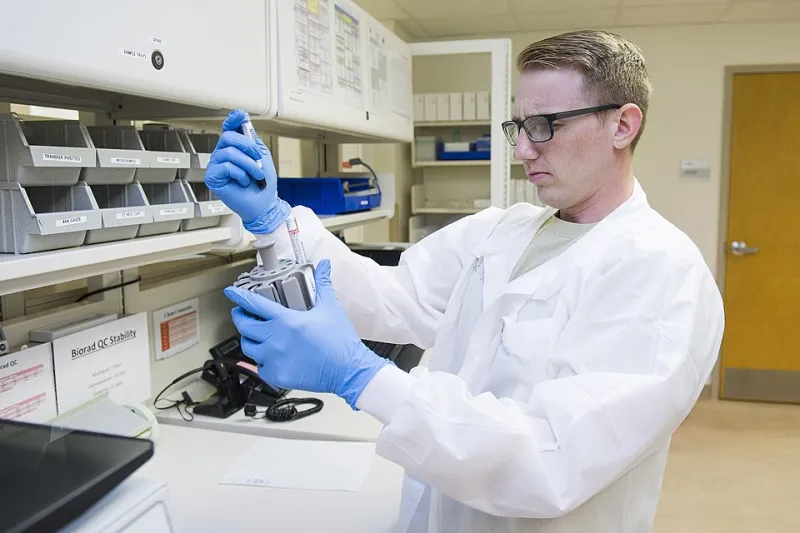
Photo: U.S. Air Force photo by Phil Sunkel, Public domain, via Wikimedia Commons
British science cinema has a type. The genius arrives late, ignores the risk assessment, gestures at a blackboard, and somehow saves the day before the tea trolley has done its second lap. It is a fine dramatic tradition, and it has given us some magnificent cardigans. But watch the edges of the frame and you will notice another story: the technician passing the clamp, the store-room keeper unlocking the cupboard marked “no, really”, the props handler quietly replacing the glassware that the lead actor has just put down with unnecessary force.
These are not usually the people who get the poster. They are the people who make the poster look scientifically plausible.
The hands that pass the clamp
A good lab technician on screen does not announce themselves. They arrive with a rack, a clipboard, or a look of mild professional concern. They adjust a dial by two degrees. They remove a Bunsen burner from a character who has been allowed near it for plot reasons. In a British production, this often reads as class, not just craft: the boffin gets the close-up, while the person in the nylon overalls gets the job of making the boffin’s nonsense look like a Tuesday morning at a research institute.
That is why technician performances can feel more scientifically truthful than the dialogue around them. Science is mostly maintenance: calibration, labelling, cleaning, checking, repeating. A film that shows someone signing out a key or wiping a bench is doing something quietly radical. It is admitting that knowledge has a filing system.
Six screen moments where the bench speaks louder than the lead
Not every example below is a documentary, and not every technician is named. That is rather the point. In each case, the small, precise actions around the main experiment carry more truth than the big speech about “the breakthrough”.
1. The Man in the White Suit (1951). Ealing’s textile-lab comedy is usually discussed as a satire of industry and invention, but its lab benches are a lovely study in practical clutter. The scientist may be the engine of the plot, yet the mill’s routines — the samples, the washing, the handling of fabric — keep reminding us that chemistry has to survive contact with a works canteen. The technician’s realm is not glamorous here. It is damp, fibrous and entirely believable.
2. The Dam Busters (1955). The famous bouncing bomb sequence tends to dominate, but the film’s backroom scenes are full of the unsung grammar of engineering: drawings, models, calculations, workshop adjustments. The boffins get the arguments; the workshop gets the tolerances. Watch the hands that make the apparatus real and you are watching the difference between an idea and a thing that might actually leave the ground.
3. The Imitation Game (2014). Bletchley Park is presented as a battle of minds, but the Bombe machines need operators, engineers and maintenance. The Wrens and technicians who keep the machinery running are part of the scientific texture, even when the script is busy admiring the lead. A code-breaking hut without its technical staff is just a very tense office with poor heating.
4. Hawking (2004). The BBC drama understands that Cambridge science is not only blackboards and revelation. It is corridors, equipment, supervision and the awkward business of being a junior researcher among people who already have their own mugs. The technical and domestic support around Hawking’s work does not steal scenes. It grounds them. That is often the technician’s best trick.
5. The Girl with All the Gifts (2016). British science fiction often uses the lab as a pressure cooker, and this film is no exception. The technicians and support staff who maintain the facility are not the emotional centre, but they establish the rules that make the horror work: containment, procedure, access, decontamination. When those rules fail, the audience feels it because the background work had been quietly doing its job.
6. Ex Machina (2015). A more stylised example, but a useful one. The lab-house is a machine that must be maintained, calibrated and cleaned. The film is fascinated by the creator, yet its unease comes from the maintenance of the environment around him. Someone, somewhere, is dealing with the coolant. That is the technician’s revenge: the plot may be about transcendence, but the air conditioning still needs a service.
What British productions lose when technicians are scenery
When a production treats technical staff as set dressing, the science starts to float. Glassware appears without racks. Centrifuges run without balances. People handle samples as if the sample were a prop and not a potential hazard. UK audiences may not all work in labs, but plenty have sat through a school practical, a hospital appointment or a factory tour. They know the smell of a store cupboard and the particular authority of someone with a key.
There is also a British cultural point here. Our screen science has often been suspicious of the grand individual. We like our boffins eccentric, our institutions shabby, our breakthroughs interrupted by rain. The technician fits that tradition perfectly: sceptical, practical, faintly unimpressed. They are the antidote to the lone-genius myth, and they are usually better written by reality than by a script editor.
None of this is a demand that every lab scene include a credit sequence for the person holding the clipboard. Drama needs compression. But there is a difference between compressing a role and erasing its function. The best British science films let the background hands do a little acting. They let the bench argue back.
The uncredited beaker is not a symbol of neglect. It is a test of whether the film has been paying attention. And in the best cases, the technician passes it without spilling a drop.