Red Pen at the Ready: Six Things Telly Scientists Get Wrong, According to the People Paid to Fix Them
Photo: Prosperosity, CC BY 4.0, via Wikimedia Commons
There is a particular noise a science consultant makes when a character on screen picks up a pipette and holds it like a fountain pen. It is not a shout. It is a small, defeated exhale — the sound of a professional deciding, for the fourth time this episode, to let something go. We asked a handful of UK researchers who have worked as advisers on drama, documentary and children's telly to describe that noise, and then to explain what would stop them making it.
Their answers were not what you'd expect. Nobody wanted a lecture. Nobody wanted a whiteboard scene explaining entropy. What they wanted, almost universally, was to be in the room earlier.
The howlers are rarely the ones you've heard of
Ask a non-scientist what telly gets wrong and you'll get the greatest hits: the defibrillator that restarts a flatline, the lab with no fume cupboard, the geneticist shouting "the DNA is mutating!" at a monitor.
Ask a consultant and the list gets smaller, stranger and much more specific.
"Microscopes," says one adviser, who has worked on three returning drama series and asked not to be named because she'd like a fourth. "Always the microscopes. A character looks down an eyepiece at something that has been described in dialogue as a virus. Do you know what a virus looks like down a light microscope? Nothing. A smudge. Possibly not even a smudge. So either your script is about electron microscopy, in which case there's no eyepiece and the scene is entirely about a screen, or your scene is a lie."
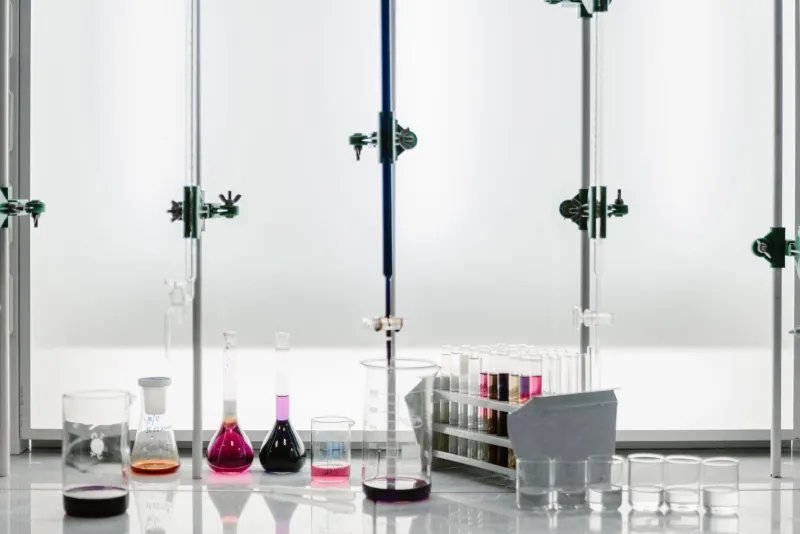
Another consultant, a chemist with a sideline in telly, has a standing complaint about glassware. "A round-bottomed flask on a bench, no clamp, filled with something lurid and gently steaming. That's not a lab. That's a lava lamp with a chemistry degree."
And then there's the perennial: a scientist in a full face shield and double gloves, typing on a keyboard, in a room with no visible extraction. "I once got sent a script where the note said 'make it look dangerous.' I wrote back and said the most dangerous thing in this shot is what happens when he tries to take those gloves off."
What actually sells a scene
The consultants were, without exception, warm about the industry they work in. They are not the fun police. Several said the moments that work best are the ones where the production has thought about behaviour rather than equipment.
"The single best note I ever gave," says a consultant who has worked across natural history and science documentary, "was that my character would not be amazed. She'd be annoyed. She's been running this experiment for six weeks. She's not gasping at the result — she's checking whether she contaminated the sample. That's the scene. That's a human being."
Another mentioned a scene she fought to keep: a researcher washing up. Not a montage, not a meaningful long shot of glassware gleaming in the window light. Just a person at a sink, sleeves rolled up, doing the least cinematic task in science.
"The director hated it. Then the editor put it in and the whole sequence suddenly had weight, because you'd seen the labour. Audiences are not stupid. They know science is mostly tidying up."
This is the argument the consultant corps keeps making, and it is a production argument rather than a pedantry argument. Specificity is cheap. A clamp costs nothing. Saying "she's checking the sample, not celebrating it" costs nothing. Getting a real researcher to read the scene at draft stage costs a day, maybe two.
The 2026 budget conversation
Here is where the money enters the room, so let's talk about money.
The consultants we spoke to were near-unanimous on one point: they are usually called in far too late. Not at script stage, but after the shoot, when the footage is locked and a producer wants a signature confirming that the fictional university's fictional grant number is fictional in a plausible way.
"By then the only thing I can do is write a note nobody will action," one says. "I have been paid to be ignored. It's a good rate. I'd rather have a worse rate and a better script."
For 2026 commissions, the practical suggestion is unglamorous: put the adviser in the schedule as a recurring line item from development onward, not as a compliance tick at delivery. Two half-days at outline and draft, one on set for anything involving hands and kit, one at fine-cut. That is not a threat to the drama. It is a way of stopping the drama from accidentally being about the wrong machine.
"Audiences have never been more science-literate and never more willing to say so online," says one consultant. "Your first inaccurate close-up is now a review. That's not me being precious. That's just the market."
The consultant's red-pen checklist
Handed to writers and producers, in their own words, lightly edited for length:
- Write the action, not the apparatus. If the scene only works because the equipment is expensive, the scene doesn't work.
- Decide what the character knows. A PhD student and a professor handle the same failed experiment completely differently. Free characterisation, sitting right there.
- No scientist celebrates a result without checking it. Excitement is a second draft of the reaction, not the first.
- Ask what the room smells like. If the answer is "nothing," you've written a showroom.
- Gloves come off before the keyboard, the phone, the door handle and the face. This is a real, tiny, extremely legible tell.
- Nobody says "the specimen is mutating" unless they are the sort of person who also says "enhance."
- Pay your adviser for the draft, not the delivery. The note that saves you is the one you get before you shoot it.
- One correct detail beats six plausible ones. Audiences forgive a fictional machine. They do not forgive fingers through the glassware.
The takeaway, which is not the one you think
None of this is a plea for realism as an aesthetic. British screen science at its best is not accurate — it is specific. There's a difference, and it's the difference between a set that smells of a lab and a set that merely looks like one.
Or, as one consultant put it, sliding her red pen back into her bag: "I don't want to write your show. I want to stop it embarrassing itself. Those are different jobs, and only one of them needs a budget line."
Fair enough. Now somebody clamp that flask.